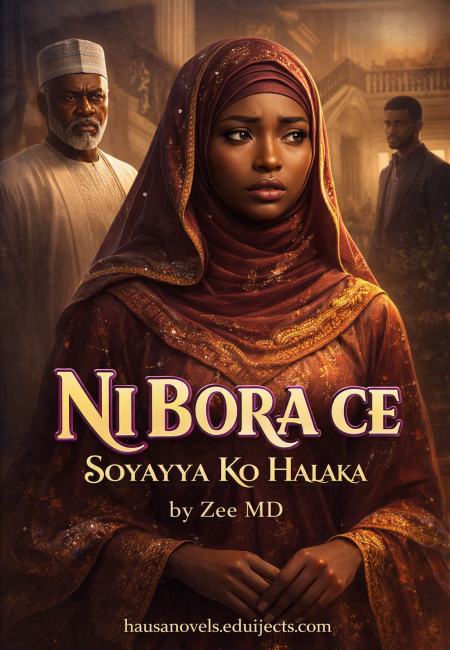
Hanan thought marriage would take her from the hardships of her childhood into a safer and more settled life. Instead, three days after entering Alhaji Nasir's enormous household, she finds herself trapped in a life she never imagined for herself. Surrounded by co-wives, twenty-seven children, rigid expectations, fear, and a husband she cannot trust, Hanan quickly realizes that the house she has entered is governed by rules far more complicated than she was prepared to face.
But Hanan's suffering did not begin with her marriage. Her story stretches back to a childhood shaped by loss, family conflict, poverty, jealousy, and difficult choices. Now, as the consequences of those choices begin to catch up with her, she must find a way to survive a household where even kindness can come with conditions and where the people closest to her may hold pieces of a much larger story.
Summary
NI BORA follows Hanan, a young woman whose life has been shaped by circumstances beyond her control. Born and raised in Jos, Hanan grows up under the care of her mother after a devastating chain of family tragedies changes the direction of their lives. Her father dies suddenly when she is still very young, leaving her mother, Ammi, to struggle with grief and responsibility while raising Hanan in an increasingly difficult household.
Hanan's childhood is further complicated by her uncle Idi and his wife Safara'u. What begins as an ordinary extended family arrangement gradually becomes a source of resentment, accusations, jealousy, and emotional hardship. Safara'u's inability to have children initially fuels suspicion toward Ammi, and her attitude toward Hanan becomes increasingly hostile. After her husband dies, Ammi is left to carry the family forward through sheer determination, supporting Hanan through small businesses and personal sacrifices while refusing several marriage offers because she wants to protect her daughter.
As Hanan grows older, another important chapter of her life begins when her mother's relatives from Lagos visit. Among them is Zunnur, a quiet and seemingly stern young man who leaves a strong impression on Hanan. Their families share a close bond, but years pass before their relationship can be understood in a different light. By the time Hanan reaches secondary school, she is beginning to experience the pressures of adulthood, attention from young men, expectations surrounding marriage, and the difficult question of what future she can realistically build for herself.
Her mother's financial struggles eventually influence Hanan's decision about education and marriage. Although she is still young and has dreams of her own, she understands that Ammi cannot afford to provide everything she needs. She therefore begins to accept the possibility of marriage, even while uncertainty remains in her heart. What she does not know is that the decision will lead her into a household where she will have to learn survival almost immediately.
That household belongs to Alhaji Nasir, a powerful man with multiple wives and twenty-seven children. Hanan's arrival is anything but peaceful. Her first days expose her to fear, humiliation, painful expectations, and an unfamiliar system in which every woman appears to have her place. Nasma becomes one of the few people willing to show her compassion, while Hajiya Hajjo represents another force Hanan must learn to navigate. And as Hanan begins to uncover the complicated relationships inside the house, the question becomes unavoidable: how much can she endure before something inside her finally breaks?
Genre and Setting
NI BORA is a Hausa family drama and relationship-centered story with elements of domestic conflict, marriage drama, romance, suspense, emotional struggle, and social commentary. The narrative moves between Hanan's childhood experiences and her later life as a young bride, allowing readers to understand how the events of her past influence the decisions she makes in the present.
The story is rooted in Northern Nigerian family and social settings, particularly Jos and the wider family connections extending to Lagos. Much of the later tension takes place inside Alhaji Nasir's large household, where several wives, numerous children, and different personalities create a complicated social environment. The home becomes more than simply a setting. It becomes a world of its own, with its own hierarchy, expectations, rivalries, alliances, and hidden tensions.
Core Themes
At its heart, NI BORA explores the difficult realities of marriage and family life. It examines what happens when a young woman enters a marriage without fully understanding the environment she is entering and how quickly an unfamiliar household can test her courage.
The novel also explores sacrifice and motherhood through Ammi's story. After losing her husband, she refuses to surrender to despair and instead finds ways to provide for Hanan. Her journey demonstrates the enormous sacrifices parents can make for their children, even when their own lives are filled with hardship.
Jealousy and family rivalry form another important thread. Safara'u's relationship with Ammi demonstrates how suspicion and resentment can gradually poison relationships within a household. The story also examines how children can become innocent victims of conflicts created by adults.
The theme of survival becomes particularly important once Hanan enters Alhaji Nasir's household. She has to learn unfamiliar responsibilities, deal with intimidating personalities, and understand the rules of a home where she initially feels completely powerless.
There is also a developing theme of love, attraction, and emotional confusion. Hanan's encounters with Zunnur, Muktar, and the expectations surrounding marriage introduce questions about the difference between affection, attention, control, protection, and genuine emotional connection.
Key Characters
Hanan is the central character and the emotional heart of the story. She is introduced as a young woman whose innocence is repeatedly confronted by difficult circumstances. Her childhood experiences have already taught her about loss and hardship, but marriage exposes her to an entirely different kind of struggle. Her journey is ultimately about discovering how much strength she possesses beneath her vulnerability.
Ammi is Hanan's mother and one of the story's most significant figures. After losing her husband, she becomes the primary source of support for her daughter. Through small businesses and personal sacrifice, she keeps Hanan's future in mind even when her own circumstances are difficult. Her decisions have a profound influence on Hanan's eventual path.
Kawu Idi occupies a complicated position in Hanan's childhood and later life. As her father's younger brother, he is initially part of the family structure that raises her, but his choices and decisions contribute significantly to the circumstances that eventually shape Hanan's future.
Safara'u is a major source of conflict within Hanan's early family life. Her jealousy toward Ammi and hostility toward Hanan create an atmosphere of tension that lasts for years. Her character demonstrates how unresolved resentment can affect an entire household.
Alhaji Nasir is Hanan's husband and the dominant figure in her new household. His arrival in the narrative immediately changes the direction of Hanan's life. His authority, temperament, and expectations make him a frightening presence for her, while his large family creates an environment Hanan struggles to understand.
Nasma provides Hanan with a rare sense of compassion after her arrival at Alhaji Nasir's home. Rather than treating Hanan as an outsider, she attempts to guide and comfort her. Her willingness to help becomes especially significant because Hanan desperately needs someone who understands the household's rules.
Hajiya Hajjo represents the strict hierarchy Hanan encounters inside her new home. She expects obedience and immediately places responsibilities on the new bride, making it clear that Hanan will not be given much time to adjust.
Zunnur is a quiet and serious young man connected to Hanan's extended family. His reserved personality makes him difficult for Hanan to understand, yet his actions toward her reveal that he pays considerably more attention to her than his silence suggests.
Haidar is more open and sociable than Zunnur. His friendly relationship with Hanan provides a contrast to Zunnur's reserved nature and contributes to the warmth of the family's interactions.
Afrah is Hanan's close companion and Zunnur's younger sister. Her playful personality and relationship with Hanan create moments of lightness within an otherwise increasingly complicated story.
Analytics and Insight
The strongest narrative element in NI BORA is its use of Hanan's past to explain her present. Rather than presenting her marriage as an isolated event, the story gradually reveals the experiences that shaped her understanding of family, responsibility, money, love, and marriage.
The contrast between Ammi's home and Alhaji Nasir's household is also significant. Hanan moves from a relatively small and economically limited environment into a large household filled with people and competing expectations. Yet the larger house does not necessarily provide greater emotional security. This contrast creates one of the novel's central tensions: a place can be physically larger without feeling emotionally safer.
The story also uses relationships as its main source of suspense. Hanan's future is influenced not only by her own choices but by decisions made by parents, relatives, husbands, and other members of the family. This creates an atmosphere where readers are encouraged to question what each relationship truly means and what consequences may emerge from it.
Another compelling aspect is the gradual development of Hanan's connection with Zunnur. His reserved personality contrasts sharply with the more openly expressive characters around him. His protective behavior toward Hanan raises questions about whether his actions are simply those of a concerned family member or whether something deeper is developing beneath the surface.
Ultimately, NI BORA is a story about a young woman standing at the intersection of childhood, marriage, family expectations, and adulthood. Hanan is not simply entering a new home. She is entering a completely different world, and every experience inside that world has the potential to change who she becomes.
A Quote to Capture the Story
“Sometimes the house that receives you is not the home you imagined, and sometimes survival begins with learning the rules of a world you never chose.”
Why Readers May Find It Compelling
NI BORA combines family history, marriage drama, emotional conflict, suspense, and complicated relationships to create a story where Hanan's future remains uncertain. Her journey begins with a difficult childhood, continues through an increasingly complicated adolescence, and eventually leads her into a marriage that immediately challenges everything she thought she knew about life.
The deeper question is not simply whether Hanan will survive her new circumstances. It is whether she will remain the same person after everything she experiences. As old family wounds, new relationships, hidden emotions, and the rules of her husband's household collide, Hanan's story becomes one of endurance, discovery, and transformation.
NI BORA invites readers into a world where family can be both shelter and source of conflict, where marriage can open an unexpected chapter, and where the quietest relationships may carry the greatest secrets.



![<? $row['name']; ?>](https://hausanovels.edujects.com/Public/thumb/225x325/ebook/2026/01/thumb-696268211478.webp)
![<? $row['name']; ?>](https://hausanovels.edujects.com/Public/thumb/225x325/ebook/2026/01/thumb-215712317518.webp)
![<? $row['name']; ?>](https://hausanovels.edujects.com/Public/thumb/225x325/ebook/2026/01/thumb-310661014079.webp)
![<? $row['name']; ?>](https://hausanovels.edujects.com/Public/thumb/225x325/ebook/2026/01/thumb-718396567317.webp)
![<? $row['name']; ?>](https://hausanovels.edujects.com/Public/thumb/225x325/ebook/2026/01/thumb-679720274629.webp)
![<? $row['name']; ?>](https://hausanovels.edujects.com/Public/thumb/225x325/ebook/2026/01/thumb-977849158452.webp)
![<? $row['name']; ?>](https://hausanovels.edujects.com/Public/thumb/225x325/ebook/2026/01/thumb-671427641031.webp)
![<? $row['name']; ?>](https://hausanovels.edujects.com/Public/thumb/225x325/ebook/2026/01/thumb-162148377183.webp)
![<? $row['name']; ?>](https://hausanovels.edujects.com/Public/thumb/225x325/ebook/2026/01/thumb-620095653013.webp)
![<? $row['name']; ?>](https://hausanovels.edujects.com/Public/thumb/225x325/ebook/2026/01/thumb-537373635516.webp)
![<? $row['name']; ?>](https://hausanovels.edujects.com/Public/thumb/225x325/ebook/2026/01/thumb-488913675831.webp)
![<? $row['name']; ?>](https://hausanovels.edujects.com/Public/thumb/225x325/ebook/2026/01/thumb-971495158370.webp)
NI BORA
By Zee MD
Opening Hook
Hanan thought marriage would take her from the hardships of her childhood into a safer and more settled life. Instead, three days after entering Alhaji Nasir's enormous household, she finds herself trapped in a life she never imagined for herself. Surrounded by co-wives, twenty-seven children, rigid expectations, fear, and a husband she cannot trust, Hanan quickly realizes that the house she has entered is governed by rules far more complicated than she was prepared to face.
But Hanan's suffering did not begin with her marriage. Her story stretches back to a childhood shaped by loss, family conflict, poverty, jealousy, and difficult choices. Now, as the consequences of those choices begin to catch up with her, she must find a way to survive a household where even kindness can come with conditions and where the people closest to her may hold pieces of a much larger story.
Summary
NI BORA follows Hanan, a young woman whose life has been shaped by circumstances beyond her control. Born and raised in Jos, Hanan grows up under the care of her mother after a devastating chain of family tragedies changes the direction of their lives. Her father dies suddenly when she is still very young, leaving her mother, Ammi, to struggle with grief and responsibility while raising Hanan in an increasingly difficult household.
Hanan's childhood is further complicated by her uncle Idi and his wife Safara'u. What begins as an ordinary extended family arrangement gradually becomes a source of resentment, accusations, jealousy, and emotional hardship. Safara'u's inability to have children initially fuels suspicion toward Ammi, and her attitude toward Hanan becomes increasingly hostile. After her husband dies, Ammi is left to carry the family forward through sheer determination, supporting Hanan through small businesses and personal sacrifices while refusing several marriage offers because she wants to protect her daughter.
As Hanan grows older, another important chapter of her life begins when her mother's relatives from Lagos visit. Among them is Zunnur, a quiet and seemingly stern young man who leaves a strong impression on Hanan. Their families share a close bond, but years pass before their relationship can be understood in a different light. By the time Hanan reaches secondary school, she is beginning to experience the pressures of adulthood, attention from young men, expectations surrounding marriage, and the difficult question of what future she can realistically build for herself.
Her mother's financial struggles eventually influence Hanan's decision about education and marriage. Although she is still young and has dreams of her own, she understands that Ammi cannot afford to provide everything she needs. She therefore begins to accept the possibility of marriage, even while uncertainty remains in her heart. What she does not know is that the decision will lead her into a household where she will have to learn survival almost immediately.
That household belongs to Alhaji Nasir, a powerful man with multiple wives and twenty-seven children. Hanan's arrival is anything but peaceful. Her first days expose her to fear, humiliation, painful expectations, and an unfamiliar system in which every woman appears to have her place. Nasma becomes one of the few people willing to show her compassion, while Hajiya Hajjo represents another force Hanan must learn to navigate. And as Hanan begins to uncover the complicated relationships inside the house, the question becomes unavoidable: how much can she endure before something inside her finally breaks?
Genre and Setting
NI BORA is a Hausa family drama and relationship-centered story with elements of domestic conflict, marriage drama, romance, suspense, emotional struggle, and social commentary. The narrative moves between Hanan's childhood experiences and her later life as a young bride, allowing readers to understand how the events of her past influence the decisions she makes in the present.
The story is rooted in Northern Nigerian family and social settings, particularly Jos and the wider family connections extending to Lagos. Much of the later tension takes place inside Alhaji Nasir's large household, where several wives, numerous children, and different personalities create a complicated social environment. The home becomes more than simply a setting. It becomes a world of its own, with its own hierarchy, expectations, rivalries, alliances, and hidden tensions.
Core Themes
At its heart, NI BORA explores the difficult realities of marriage and family life. It examines what happens when a young woman enters a marriage without fully understanding the environment she is entering and how quickly an unfamiliar household can test her courage.
The novel also explores sacrifice and motherhood through Ammi's story. After losing her husband, she refuses to surrender to despair and instead finds ways to provide for Hanan. Her journey demonstrates the enormous sacrifices parents can make for their children, even when their own lives are filled with hardship.
Jealousy and family rivalry form another important thread. Safara'u's relationship with Ammi demonstrates how suspicion and resentment can gradually poison relationships within a household. The story also examines how children can become innocent victims of conflicts created by adults.
The theme of survival becomes particularly important once Hanan enters Alhaji Nasir's household. She has to learn unfamiliar responsibilities, deal with intimidating personalities, and understand the rules of a home where she initially feels completely powerless.
There is also a developing theme of love, attraction, and emotional confusion. Hanan's encounters with Zunnur, Muktar, and the expectations surrounding marriage introduce questions about the difference between affection, attention, control, protection, and genuine emotional connection.
Key Characters
Hanan is the central character and the emotional heart of the story. She is introduced as a young woman whose innocence is repeatedly confronted by difficult circumstances. Her childhood experiences have already taught her about loss and hardship, but marriage exposes her to an entirely different kind of struggle. Her journey is ultimately about discovering how much strength she possesses beneath her vulnerability.
Ammi is Hanan's mother and one of the story's most significant figures. After losing her husband, she becomes the primary source of support for her daughter. Through small businesses and personal sacrifice, she keeps Hanan's future in mind even when her own circumstances are difficult. Her decisions have a profound influence on Hanan's eventual path.
Kawu Idi occupies a complicated position in Hanan's childhood and later life. As her father's younger brother, he is initially part of the family structure that raises her, but his choices and decisions contribute significantly to the circumstances that eventually shape Hanan's future.
Safara'u is a major source of conflict within Hanan's early family life. Her jealousy toward Ammi and hostility toward Hanan create an atmosphere of tension that lasts for years. Her character demonstrates how unresolved resentment can affect an entire household.
Alhaji Nasir is Hanan's husband and the dominant figure in her new household. His arrival in the narrative immediately changes the direction of Hanan's life. His authority, temperament, and expectations make him a frightening presence for her, while his large family creates an environment Hanan struggles to understand.
Nasma provides Hanan with a rare sense of compassion after her arrival at Alhaji Nasir's home. Rather than treating Hanan as an outsider, she attempts to guide and comfort her. Her willingness to help becomes especially significant because Hanan desperately needs someone who understands the household's rules.
Hajiya Hajjo represents the strict hierarchy Hanan encounters inside her new home. She expects obedience and immediately places responsibilities on the new bride, making it clear that Hanan will not be given much time to adjust.
Zunnur is a quiet and serious young man connected to Hanan's extended family. His reserved personality makes him difficult for Hanan to understand, yet his actions toward her reveal that he pays considerably more attention to her than his silence suggests.
Haidar is more open and sociable than Zunnur. His friendly relationship with Hanan provides a contrast to Zunnur's reserved nature and contributes to the warmth of the family's interactions.
Afrah is Hanan's close companion and Zunnur's younger sister. Her playful personality and relationship with Hanan create moments of lightness within an otherwise increasingly complicated story.
Analytics and Insight
The strongest narrative element in NI BORA is its use of Hanan's past to explain her present. Rather than presenting her marriage as an isolated event, the story gradually reveals the experiences that shaped her understanding of family, responsibility, money, love, and marriage.
The contrast between Ammi's home and Alhaji Nasir's household is also significant. Hanan moves from a relatively small and economically limited environment into a large household filled with people and competing expectations. Yet the larger house does not necessarily provide greater emotional security. This contrast creates one of the novel's central tensions: a place can be physically larger without feeling emotionally safer.
The story also uses relationships as its main source of suspense. Hanan's future is influenced not only by her own choices but by decisions made by parents, relatives, husbands, and other members of the family. This creates an atmosphere where readers are encouraged to question what each relationship truly means and what consequences may emerge from it.
Another compelling aspect is the gradual development of Hanan's connection with Zunnur. His reserved personality contrasts sharply with the more openly expressive characters around him. His protective behavior toward Hanan raises questions about whether his actions are simply those of a concerned family member or whether something deeper is developing beneath the surface.
Ultimately, NI BORA is a story about a young woman standing at the intersection of childhood, marriage, family expectations, and adulthood. Hanan is not simply entering a new home. She is entering a completely different world, and every experience inside that world has the potential to change who she becomes.
A Quote to Capture the Story
Why Readers May Find It Compelling
NI BORA combines family history, marriage drama, emotional conflict, suspense, and complicated relationships to create a story where Hanan's future remains uncertain. Her journey begins with a difficult childhood, continues through an increasingly complicated adolescence, and eventually leads her into a marriage that immediately challenges everything she thought she knew about life.
The deeper question is not simply whether Hanan will survive her new circumstances. It is whether she will remain the same person after everything she experiences. As old family wounds, new relationships, hidden emotions, and the rules of her husband's household collide, Hanan's story becomes one of endurance, discovery, and transformation.
NI BORA invites readers into a world where family can be both shelter and source of conflict, where marriage can open an unexpected chapter, and where the quietest relationships may carry the greatest secrets.