What happens when a family loses the man who held their lives together, only to discover that his death is only the beginning of their troubles? In IGIYAR RAYUWA, grief, injustice, buried family secrets, and a love born in the middle of hardship collide in a story where the past refuses to remain buried.
At the center of the story is Khairi and her family, whose world is shattered when her father, Abba, dies suddenly in the courtroom after being sentenced for a crime his family insists he never committed. But behind that devastating moment lies a much older story, one involving Safiyya, a painful childhood, family hostility, betrayal, and a young girl whose life takes an unexpected turn after she encounters Umaru.
Summary
IGIYAR RAYUWA opens with a glimpse into Musharraf's seemingly comfortable life. He is a successful and respected man with a prominent position, a loving daughter, and a family that looks peaceful from the outside. Yet beneath that polished appearance lies a troubled past. Even in moments of comfort, Musharraf carries memories that have never truly left him. His relationship with his parents and the painful experiences he witnessed as a child continue to haunt him, hinting that there is far more to his story than his present life reveals.
Elsewhere, Abba's family is fighting a battle that threatens to destroy everything they have. Abba has been accused of a serious crime, and the courtroom becomes the stage upon which his fate is decided. His children and relatives desperately cling to the hope that the truth will emerge. His lawyer attempts to challenge the accusations, while the opposing side presents what appears to be convincing evidence. Despite the family's confidence in Abba's innocence, the judgment goes against him. Before the family can even process the devastating sentence, tragedy strikes. Abba collapses and dies in the courtroom, leaving Khairi and Abul devastated.
His death creates another crisis. The family returns home expecting at least the comfort of their own house, only to find the entrance locked and their belongings thrown outside. Suddenly, the people who have already lost their father and provider are left without a home. Their grief becomes mixed with uncertainty about where they will live, how they will survive, and what their estranged relatives intend to do next. A kindhearted neighbor steps forward to help them, providing food, shelter, and support during their darkest days.
As the family struggles to survive after Abba's death, Safiyya begins revealing the history behind the family's broken relationships. Her childhood was marked by neglect, cruelty, and loneliness. Growing up without her biological mother, she was raised under the authority of a stepmother who subjected her to relentless hardship. Her father loved her, but his absence meant he remained largely unaware of what she endured. She was treated less like a daughter and more like someone whose existence was convenient to exploit.
Then came the encounter that changed her life. As a young girl sent out before dawn to fetch water, Safiyya found herself in terrible danger. She was attacked and pursued, but fate placed Umaru in her path. He intervened and helped her escape. What began as an act of protection gradually became a deep connection between two young people living within the limitations of their environment. Yet their growing closeness attracted suspicion, gossip, and opposition. When tragedy later struck Umaru's family, Safiyya remained emotionally connected to him. Their relationship, however, was never going to exist without consequences.
The story therefore moves between different periods of the characters' lives, gradually revealing how childhood suffering, family conflicts, love, injustice, and hidden decisions shape the people they eventually become. Musharraf's troubled memories, Abba's tragic fate, Safiyya's painful upbringing, and Umaru's connection with her are not isolated events. They form pieces of a much larger story. And as more of the past comes to light, the question becomes increasingly difficult to ignore: what really happened, and how much of the present was determined by wounds that began years ago?
Genre and Setting
IGIYAR RAYUWA is a dramatic Hausa family story blending romance, tragedy, suspense, family drama, social conflict, and emotional storytelling. The novel moves between domestic spaces, rural communities, marketplaces, religious settings, professional environments, and the courtroom, allowing the story to explore both intimate family relationships and wider social realities.
The rural portions of the story provide an especially important backdrop. Safiyya's early life is shaped by village life, water-fetching, cattle, hawking, family compounds, communal expectations, and the restrictions placed upon young women. Later sections expand into more urban and institutional environments, including the Federal High Court and the professional world surrounding Musharraf. This contrast gives the novel a broad sense of time, place, and social change.
Core Themes
Family, Loyalty, and Betrayal
Family is at the heart of IGIYAR RAYUWA, but blood relationships do not always guarantee kindness. The novel examines what happens when relatives become sources of pain instead of protection, and how betrayal within a family can leave wounds that survive for generations.
Grief and Loss
Abba's death becomes one of the most emotionally devastating turning points in the story. His family must suddenly learn how to survive without the person they depended upon. Through Khairi, Abul, Dada, and the younger children, the story explores the different ways people experience grief and how loss can change an entire household.
Injustice and the Search for Truth
The courtroom storyline introduces one of the novel's strongest conflicts. Abba's family believes that he has been wrongly accused, yet the legal process appears to move toward a devastating conclusion. The story raises questions about evidence, judgment, truth, and the consequences of decisions made when the complete picture may not be known.
Childhood Trauma
Safiyya's childhood reveals how cruelty and neglect can shape a person's understanding of love, safety, and belonging. Her experiences are not simply memories from the past. They become part of the emotional foundation upon which her later relationships are built.
Love in Difficult Circumstances
Safiyya and Umaru's connection develops in an environment where they have little control over the circumstances surrounding them. Their relationship begins through protection and companionship, but family expectations, social judgment, and tragedy constantly threaten to interfere.
Fate and Human Decisions
The novel repeatedly places its characters between what they choose and what happens beyond their control. Death, family conflict, social pressure, and unexpected encounters continually reshape their lives, making the title IGIYAR RAYUWA, "The Lifeline of Life," particularly fitting.
Key Characters
Khairi is one of the characters most deeply affected by the tragedy surrounding Abba. Her attachment to her father is unmistakable, and his sudden death leaves her emotionally shattered. Her grief becomes even heavier because she believes that his death was connected to an injustice that should never have happened.
Abul emerges as a protective member of the family who must remain strong even when he is grieving himself. He takes responsibility for his younger siblings and repeatedly finds himself dealing with situations far beyond what anyone should have to endure after losing a parent.
Abba, also known as Umaru in the family history, is a central figure whose story connects the courtroom tragedy with the deeper family narrative. He is portrayed as a man known for generosity, dignity, and affection toward his family, yet his life becomes caught between accusation, family conflict, and a devastating fate.
Dada, Safiyya, carries one of the novel's most painful histories. Her childhood is marked by the loss of her mother, mistreatment by her stepmother, loneliness, and constant hardship. Her recollections provide an important window into the origins of the family's complicated relationships.
Umaru enters Safiyya's life at a moment when she desperately needs protection. His intervention creates a bond that gradually develops into companionship and affection. His own family circumstances, however, introduce another layer of hardship into their relationship.
Hamma Habu and Hamma Bawuro represent the darker side of Safiyya's family environment. Their actions contribute significantly to the fear and suffering she experiences as a young girl and help explain why the relationship between Safiyya and her relatives becomes so deeply fractured.
Musharraf presents a different mystery. In the present day, he appears successful, disciplined, and established, yet his memories reveal unresolved childhood pain. His recollections of protecting his mother from his father's violence suggest that the confident man seen in the present was shaped by experiences that were anything but comfortable.
Analytics and Insight
One of the strongest elements of IGIYAR RAYUWA is the way the story connects apparently separate events. The courtroom tragedy initially appears to be the central conflict, but the narrative gradually opens the door to an older generation and a much deeper family history. This structure gives the novel a layered quality because readers are not simply following what is happening now. They are also discovering why these characters became who they are.
The contrast between Abba's final moments and Safiyya's childhood is particularly significant. One shows a family losing its father in a public setting surrounded by lawyers, judges, accusations, and witnesses. The other shows a young girl struggling privately with fear, poverty, loneliness, and family cruelty. Together, these storylines suggest that some of the greatest battles in a person's life happen long before anyone else realizes there is a war.
Musharraf's storyline adds another dimension to the novel. His successful adult life does not erase the memories of his childhood. His recollection of his mother's suffering and his confrontation with his father suggest that the emotional consequences of family violence can follow a person long after the original events have ended. This makes his character important not only as an individual, but also as another example of how the past continues to influence the present.
The novel also uses death not simply as an ending, but as a force that exposes relationships. After Abba's death, hidden problems become impossible to ignore. The family's homelessness exposes the hostility of relatives. Their dependence on a compassionate neighbor highlights the value of kindness. Khairi's grief reveals the depth of her relationship with her father. Even the courtroom judgment takes on a different emotional meaning once the consequences become irreversible.
Most importantly, the story keeps several questions alive. Was Abba truly guilty? What really happened behind the accusations? Why did his relatives turn against his family? What became of Safiyya after the events of her youth? And how is Musharraf connected to everything that has already happened?
Those unanswered questions provide much of the novel's suspense.
A Quote From the Story
"Sometimes the greatest battles are not fought with weapons. They are fought with memories, family secrets, and the painful truth of what happened when nobody was watching."
Why Readers Should Enter the Story
IGIYAR RAYUWA is built around the kind of emotional mystery that becomes larger with every revelation. It begins with family life, moves into tragedy, then reaches backward into a painful past where love and suffering become intertwined. The story asks readers to look beyond what people appear to be and consider the experiences that shaped them.
For readers who enjoy Hausa novels filled with family secrets, emotional romance, courtroom drama, betrayal, village life, tragedy, suspense, and complicated relationships, this story offers plenty to uncover. Its greatest mystery may not be what happens next, but how everything that has already happened is connected.
And as the story continues, one question remains hanging over the characters:
How much can a person endure before the very rope holding their life together finally breaks?






![<? $row['name']; ?>](https://hausanovels.edujects.com/Public/thumb/225x325/ebook/2026/01/thumb-696268211478.webp)
![<? $row['name']; ?>](https://hausanovels.edujects.com/Public/thumb/225x325/ebook/2026/01/thumb-215712317518.webp)
![<? $row['name']; ?>](https://hausanovels.edujects.com/Public/thumb/225x325/ebook/2026/01/thumb-310661014079.webp)
![<? $row['name']; ?>](https://hausanovels.edujects.com/Public/thumb/225x325/ebook/2026/01/thumb-718396567317.webp)
![<? $row['name']; ?>](https://hausanovels.edujects.com/Public/thumb/225x325/ebook/2026/01/thumb-679720274629.webp)
![<? $row['name']; ?>](https://hausanovels.edujects.com/Public/thumb/225x325/ebook/2026/01/thumb-977849158452.webp)
![<? $row['name']; ?>](https://hausanovels.edujects.com/Public/thumb/225x325/ebook/2026/01/thumb-671427641031.webp)
![<? $row['name']; ?>](https://hausanovels.edujects.com/Public/thumb/225x325/ebook/2026/01/thumb-162148377183.webp)
![<? $row['name']; ?>](https://hausanovels.edujects.com/Public/thumb/225x325/ebook/2026/01/thumb-620095653013.webp)
![<? $row['name']; ?>](https://hausanovels.edujects.com/Public/thumb/225x325/ebook/2026/01/thumb-537373635516.webp)
![<? $row['name']; ?>](https://hausanovels.edujects.com/Public/thumb/225x325/ebook/2026/01/thumb-488913675831.webp)
![<? $row['name']; ?>](https://hausanovels.edujects.com/Public/thumb/225x325/ebook/2026/01/thumb-971495158370.webp)
IGIYAR RAYUWA
Hook
What happens when a family loses the man who held their lives together, only to discover that his death is only the beginning of their troubles? In IGIYAR RAYUWA, grief, injustice, buried family secrets, and a love born in the middle of hardship collide in a story where the past refuses to remain buried.
At the center of the story is Khairi and her family, whose world is shattered when her father, Abba, dies suddenly in the courtroom after being sentenced for a crime his family insists he never committed. But behind that devastating moment lies a much older story, one involving Safiyya, a painful childhood, family hostility, betrayal, and a young girl whose life takes an unexpected turn after she encounters Umaru.
Summary
IGIYAR RAYUWA opens with a glimpse into Musharraf's seemingly comfortable life. He is a successful and respected man with a prominent position, a loving daughter, and a family that looks peaceful from the outside. Yet beneath that polished appearance lies a troubled past. Even in moments of comfort, Musharraf carries memories that have never truly left him. His relationship with his parents and the painful experiences he witnessed as a child continue to haunt him, hinting that there is far more to his story than his present life reveals.
Elsewhere, Abba's family is fighting a battle that threatens to destroy everything they have. Abba has been accused of a serious crime, and the courtroom becomes the stage upon which his fate is decided. His children and relatives desperately cling to the hope that the truth will emerge. His lawyer attempts to challenge the accusations, while the opposing side presents what appears to be convincing evidence. Despite the family's confidence in Abba's innocence, the judgment goes against him. Before the family can even process the devastating sentence, tragedy strikes. Abba collapses and dies in the courtroom, leaving Khairi and Abul devastated.
His death creates another crisis. The family returns home expecting at least the comfort of their own house, only to find the entrance locked and their belongings thrown outside. Suddenly, the people who have already lost their father and provider are left without a home. Their grief becomes mixed with uncertainty about where they will live, how they will survive, and what their estranged relatives intend to do next. A kindhearted neighbor steps forward to help them, providing food, shelter, and support during their darkest days.
As the family struggles to survive after Abba's death, Safiyya begins revealing the history behind the family's broken relationships. Her childhood was marked by neglect, cruelty, and loneliness. Growing up without her biological mother, she was raised under the authority of a stepmother who subjected her to relentless hardship. Her father loved her, but his absence meant he remained largely unaware of what she endured. She was treated less like a daughter and more like someone whose existence was convenient to exploit.
Then came the encounter that changed her life. As a young girl sent out before dawn to fetch water, Safiyya found herself in terrible danger. She was attacked and pursued, but fate placed Umaru in her path. He intervened and helped her escape. What began as an act of protection gradually became a deep connection between two young people living within the limitations of their environment. Yet their growing closeness attracted suspicion, gossip, and opposition. When tragedy later struck Umaru's family, Safiyya remained emotionally connected to him. Their relationship, however, was never going to exist without consequences.
The story therefore moves between different periods of the characters' lives, gradually revealing how childhood suffering, family conflicts, love, injustice, and hidden decisions shape the people they eventually become. Musharraf's troubled memories, Abba's tragic fate, Safiyya's painful upbringing, and Umaru's connection with her are not isolated events. They form pieces of a much larger story. And as more of the past comes to light, the question becomes increasingly difficult to ignore: what really happened, and how much of the present was determined by wounds that began years ago?
Genre and Setting
IGIYAR RAYUWA is a dramatic Hausa family story blending romance, tragedy, suspense, family drama, social conflict, and emotional storytelling. The novel moves between domestic spaces, rural communities, marketplaces, religious settings, professional environments, and the courtroom, allowing the story to explore both intimate family relationships and wider social realities.
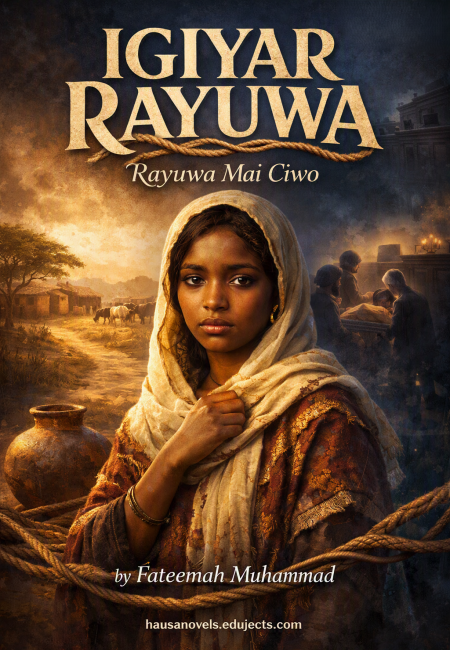
The rural portions of the story provide an especially important backdrop. Safiyya's early life is shaped by village life, water-fetching, cattle, hawking, family compounds, communal expectations, and the restrictions placed upon young women. Later sections expand into more urban and institutional environments, including the Federal High Court and the professional world surrounding Musharraf. This contrast gives the novel a broad sense of time, place, and social change.
Core Themes
Family, Loyalty, and Betrayal
Family is at the heart of IGIYAR RAYUWA, but blood relationships do not always guarantee kindness. The novel examines what happens when relatives become sources of pain instead of protection, and how betrayal within a family can leave wounds that survive for generations.
Grief and Loss
Abba's death becomes one of the most emotionally devastating turning points in the story. His family must suddenly learn how to survive without the person they depended upon. Through Khairi, Abul, Dada, and the younger children, the story explores the different ways people experience grief and how loss can change an entire household.
Injustice and the Search for Truth
The courtroom storyline introduces one of the novel's strongest conflicts. Abba's family believes that he has been wrongly accused, yet the legal process appears to move toward a devastating conclusion. The story raises questions about evidence, judgment, truth, and the consequences of decisions made when the complete picture may not be known.
Childhood Trauma
Safiyya's childhood reveals how cruelty and neglect can shape a person's understanding of love, safety, and belonging. Her experiences are not simply memories from the past. They become part of the emotional foundation upon which her later relationships are built.
Love in Difficult Circumstances
Safiyya and Umaru's connection develops in an environment where they have little control over the circumstances surrounding them. Their relationship begins through protection and companionship, but family expectations, social judgment, and tragedy constantly threaten to interfere.
Fate and Human Decisions
The novel repeatedly places its characters between what they choose and what happens beyond their control. Death, family conflict, social pressure, and unexpected encounters continually reshape their lives, making the title IGIYAR RAYUWA, "The Lifeline of Life," particularly fitting.
Key Characters
Khairi is one of the characters most deeply affected by the tragedy surrounding Abba. Her attachment to her father is unmistakable, and his sudden death leaves her emotionally shattered. Her grief becomes even heavier because she believes that his death was connected to an injustice that should never have happened.
Abul emerges as a protective member of the family who must remain strong even when he is grieving himself. He takes responsibility for his younger siblings and repeatedly finds himself dealing with situations far beyond what anyone should have to endure after losing a parent.
Abba, also known as Umaru in the family history, is a central figure whose story connects the courtroom tragedy with the deeper family narrative. He is portrayed as a man known for generosity, dignity, and affection toward his family, yet his life becomes caught between accusation, family conflict, and a devastating fate.
Dada, Safiyya, carries one of the novel's most painful histories. Her childhood is marked by the loss of her mother, mistreatment by her stepmother, loneliness, and constant hardship. Her recollections provide an important window into the origins of the family's complicated relationships.
Umaru enters Safiyya's life at a moment when she desperately needs protection. His intervention creates a bond that gradually develops into companionship and affection. His own family circumstances, however, introduce another layer of hardship into their relationship.
Hamma Habu and Hamma Bawuro represent the darker side of Safiyya's family environment. Their actions contribute significantly to the fear and suffering she experiences as a young girl and help explain why the relationship between Safiyya and her relatives becomes so deeply fractured.
Musharraf presents a different mystery. In the present day, he appears successful, disciplined, and established, yet his memories reveal unresolved childhood pain. His recollections of protecting his mother from his father's violence suggest that the confident man seen in the present was shaped by experiences that were anything but comfortable.
Analytics and Insight
One of the strongest elements of IGIYAR RAYUWA is the way the story connects apparently separate events. The courtroom tragedy initially appears to be the central conflict, but the narrative gradually opens the door to an older generation and a much deeper family history. This structure gives the novel a layered quality because readers are not simply following what is happening now. They are also discovering why these characters became who they are.
The contrast between Abba's final moments and Safiyya's childhood is particularly significant. One shows a family losing its father in a public setting surrounded by lawyers, judges, accusations, and witnesses. The other shows a young girl struggling privately with fear, poverty, loneliness, and family cruelty. Together, these storylines suggest that some of the greatest battles in a person's life happen long before anyone else realizes there is a war.
Musharraf's storyline adds another dimension to the novel. His successful adult life does not erase the memories of his childhood. His recollection of his mother's suffering and his confrontation with his father suggest that the emotional consequences of family violence can follow a person long after the original events have ended. This makes his character important not only as an individual, but also as another example of how the past continues to influence the present.
The novel also uses death not simply as an ending, but as a force that exposes relationships. After Abba's death, hidden problems become impossible to ignore. The family's homelessness exposes the hostility of relatives. Their dependence on a compassionate neighbor highlights the value of kindness. Khairi's grief reveals the depth of her relationship with her father. Even the courtroom judgment takes on a different emotional meaning once the consequences become irreversible.
Most importantly, the story keeps several questions alive. Was Abba truly guilty? What really happened behind the accusations? Why did his relatives turn against his family? What became of Safiyya after the events of her youth? And how is Musharraf connected to everything that has already happened?
Those unanswered questions provide much of the novel's suspense.
A Quote From the Story
Why Readers Should Enter the Story
IGIYAR RAYUWA is built around the kind of emotional mystery that becomes larger with every revelation. It begins with family life, moves into tragedy, then reaches backward into a painful past where love and suffering become intertwined. The story asks readers to look beyond what people appear to be and consider the experiences that shaped them.
For readers who enjoy Hausa novels filled with family secrets, emotional romance, courtroom drama, betrayal, village life, tragedy, suspense, and complicated relationships, this story offers plenty to uncover. Its greatest mystery may not be what happens next, but how everything that has already happened is connected.
And as the story continues, one question remains hanging over the characters:
How much can a person endure before the very rope holding their life together finally breaks?